
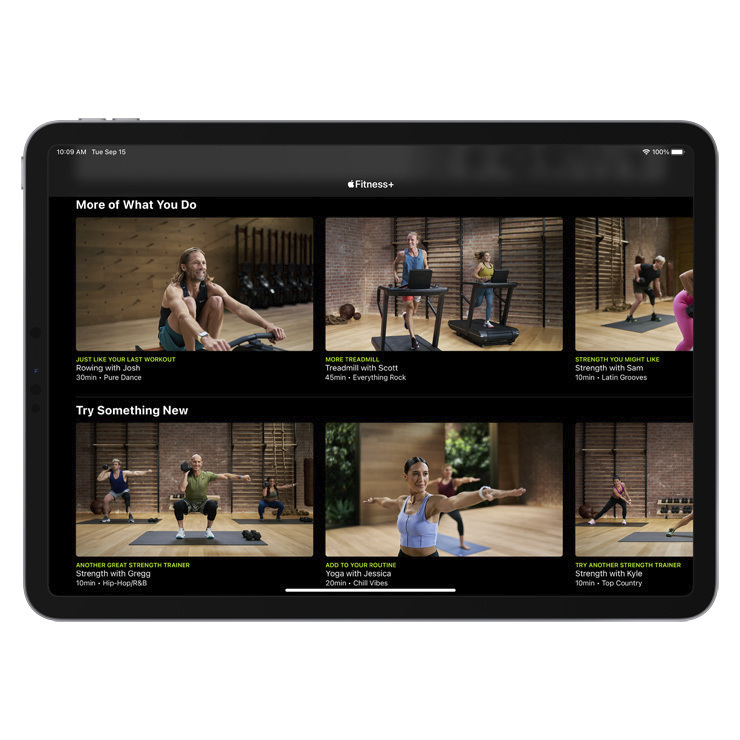
I’m glistening. My heart rate is finally slowing a bit as I type this. The slightest hints of my asthma are subsiding. I’m not going to tell you I feel “good,†as relative as that term might be in a year when everything has gone to hell somehow both gradually and all at once over the course of 12 awful months. But I certainly don’t feel “bad,†either.
There is, of course, a kind of serendipity in today’s launch of Fitness+. While Apple gets points for general prescience, one assumes the company wasn’t privy to any better information than the rest of us, and certainly couldn’t have predicted how radical a shift the exercise industry would undergo over the past nine months.
Most of the information on COVID-19’s impact on gyms is, at best, either myopic or anecdotal, but there seems little doubt the industry has been — and will continue to be — radically impacted by the pandemic. “Devastated†might be a more accurate term. After all, it’s mid-December as I’m writing this and many are still scared to venture back into a business that routinely ranks among the highest risk for the virus’s spread. As if people needed another excuse to skip daily workouts.
What we can say for certain, however, is that Wall Street and Silicon Valley cultures have reacted, big time. In late-June, Lululemon purchased Mirror for a jaw-dropping $500 million. Shortly after, Bank of America started tossing out predictions, noting the guided workout company could generate $700 million and hit 600,000 subscribers by 2023. Peloton stock hit a slight blip with Apple’s Fitness+ launch announcement last week, but otherwise, it’s a been a terrific year from the home treadmill/stationary bike maker.
None of this is to say, of course, that these companies weren’t already doing gangbusters, but the pandemic has certainly — in the words of an overzealous fitness instructor — kicked it up a notch. Yes, I grimaced a bit as I wrote that last sentence, but ultimately, what is a fitness class if not an exercise in swallowing one’s pride?
My own experience with group workouts is limited. Prior to the pandemic, I went to the gym five to seven days a week. When on a work trip, I would be the weirdo at the hotel gym, trying to figure out how to change the one giant-tube television from Fox News at 6AM. I don’t care what your political leanings are — no Fox and Friends for me before coffee and a run.
Since the pandemic, my options have been…limited. In addition to the harrowing COVID fallout in my home of Queens in March/April, I dealt with some of my own health complications that severely limited my workout options. I’ve weaned myself back into a kind of makeshift workout regimen in the intervening few months — first through some YouTube yoga and now through five to 15-mile daily walks.
It’s an improvement. And I’m counting my blessings and all of that, knowing well that as bad as things had and have gotten, they ultimately could be worse. Truth is, though, like many Americans (and non-Americans, no doubt), the cost-benefit analysis of going back to the gym still doesn’t make a heck of a lot of sense for me. Given the space constraints of my New York City apartment, however, neither does a Peloton.
I do, however, have an Apple Watch. And a yoga mat. And just about enough space in my bedroom to make this work. I’ve been at this for a few days — doing a couple of workouts a day, ranging from about 10 to 20 minutes a piece. Like Matthew did last week with his AirPods Max writeup, I’m going to opt not to call this a “review.†It’s not fair to the product and — more to the point — it’s not fair to you, the reader.
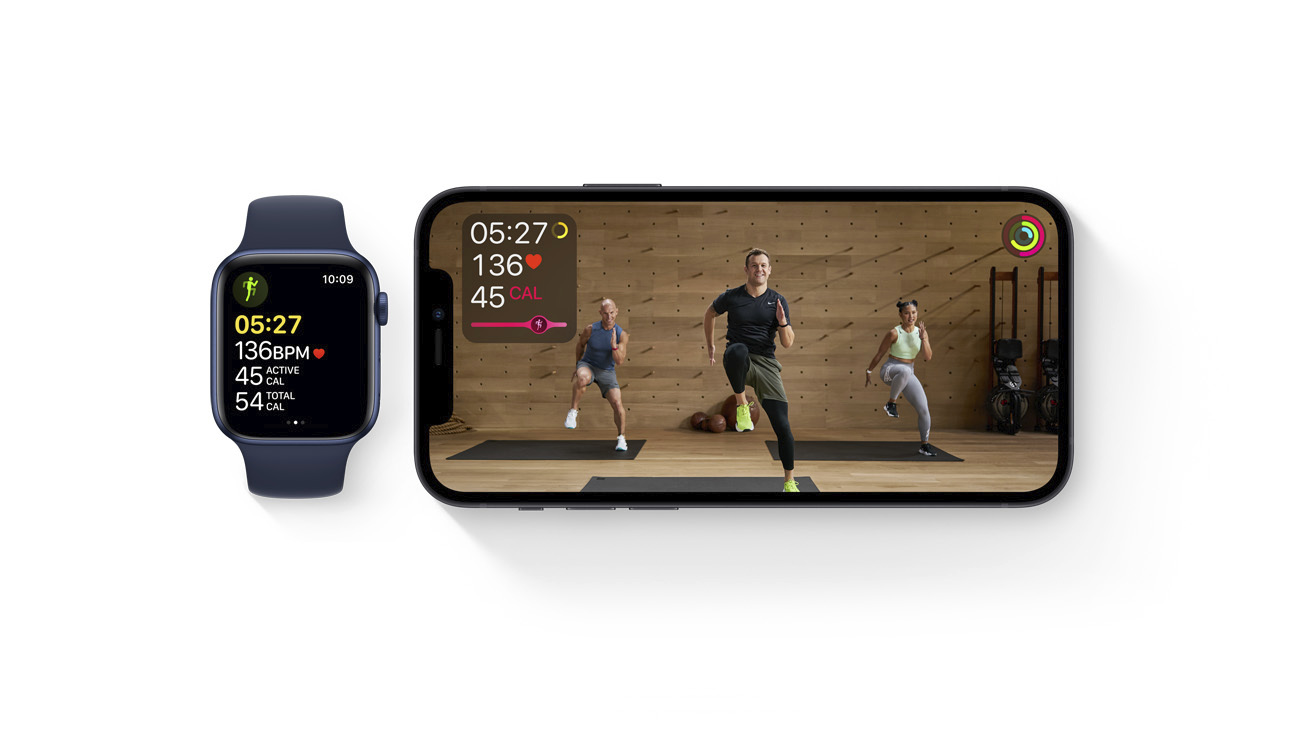
Image Credits: Apple
What I can say definitely, however, is that I do plan to continue using the service beyond these first few days. Perhaps that’s a testament to the product’s potential. Or maybe it’s just a sign that I’m looking for a way to stop feeling like a wet garbage bag full of room temperature cottage cheese all of the time. The truth, as usual, probably lies somewhere in the middle.
Fitness — like anything health related — is a highly personal thing. There has never and likely will never be a kind of one-size-fits-all solution to the problem of working out. And while Fitness+ is the latest, shiny attempt to tackle the issue, that’s certainly the case here as well. The best I can do for you right now is discuss my own personal needs and experiences. Some will likely sound familiar, others not.
My biggest fitness hurdles are: time and space. The time bit should be self-explanatory — and familiar to most. Even during a year-long quarantine, there’s somehow never enough of the stuff. Space is mostly — but not entirely — a side effect of my decision to live in New York City on a journalist’s salary.
There’s also the matter of variety. Once I find something I like at a particular restaurant, I will continue to order it until I’m sick of it. And that likely won’t be for a while. That’s usually the case with how I work out as well (likely to the detriment of my overall health). Once I discovered that I could tolerate running (and keep the pounds off doing it), I ran until I messed up both of knees.
As I said above, walking long distances across bridges and into different boroughs has been a small but important respite for me during hell year. In doing that, I’ve pretty consistently closed my Apple Watch rings (“Stand†can still be a stickler on work days). But while I generally don’t have an issue hitting those goals, switching up how I can get there has been something of a challenge.
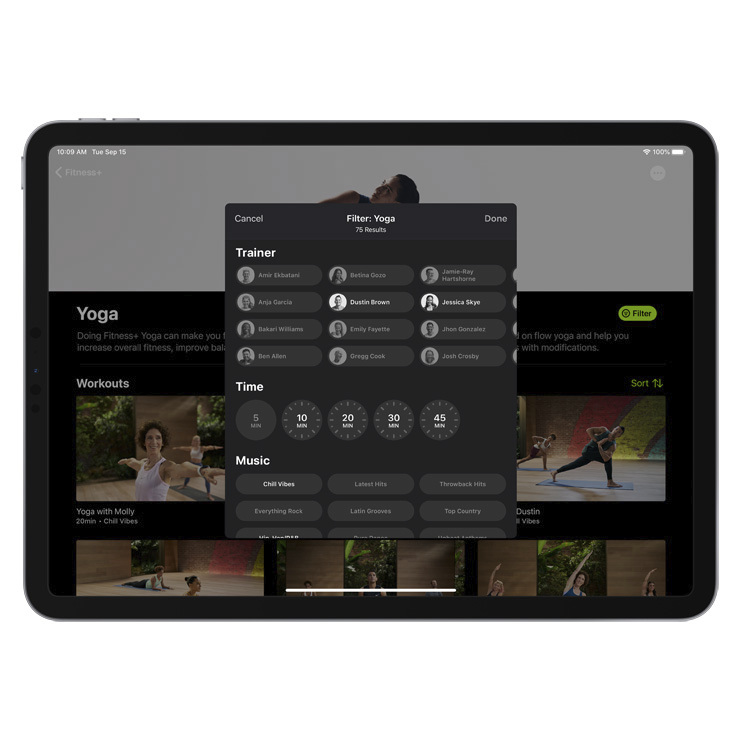
Image Credits:
Fitness+ does offer some key benefits right off the bat. The first — and arguably most important — is convenience. For $10 a month, you get whatever peace of mind comes with knowing that every Monday, Apple is going to drop a new crop of new workout videos for you every week. That content can be accessed across a number of Apple devices. Namely: the iPhone, iPad and Apple TV.
Another thing you should probably know about me (you’re learning all sorts of fun stuff today, right?) is that I’m one of those no TV weirdos, and therefore my own experiences are limited to the iPad and iPhone. There are a number of reasons to go for the Apple TV in this setup, but the most important of all, to be honest, is sheer screen real estate. I found the iPad Air’s 11-inch display was totally acceptable in close range, however.
The iPhone was a lot trickier, on the other hand, when it comes to following the trainers. The upshot of both of these, however, is flexibility. That’s a nice feature when it comes to moving between standing and sitting exercises. The other big upshot will come when we all start traveling again. I can certainly see the appeal of busting out one or two of these workouts in my hotel room, instead of gambling that the elliptical machine will be up and running (about 50/50 in my experience).
For now, at least, Fitness+ doesn’t have its own standalone app. Like other premium services before it, Apple’s snuck it into an update of an existing app — a move that ensures the new paid offering is instantly available on millions of devices starting today. In the iPhone app, it appears as one of three tabs. It always felt a little superfluous to have individual apps for Fitness, Health and Watch, but I suppose that now we know why they’ve kept those things separate. Today also marks the arrival of the standard Fitness app for iPadOS, where Fitness+ is more or less the entire experience.
The Apple Watch is required for the Fitness+ experience. There’s apparently a way to circumvent things if, say, you accidentally forgot your Watch at home or your battery dies or what have you. But on the whole, no watch, no Fitness+. Ecosystem’s gonna ecosystem, friend.
The necessity for this particular piece of hardware makes sense when you consider how deeply integrated it is. The Watch really is the core of the Fitness+ experience. It does its usual job collecting your metrics, which are now also displayed for you in real time on screen as you work out. The primary information at the ready is how far you are into the activity bar and your heart rate — the latter in particular seems like an important piece of information for many. And it is pretty fascinating to watch your numbers climb and drop between intervals.
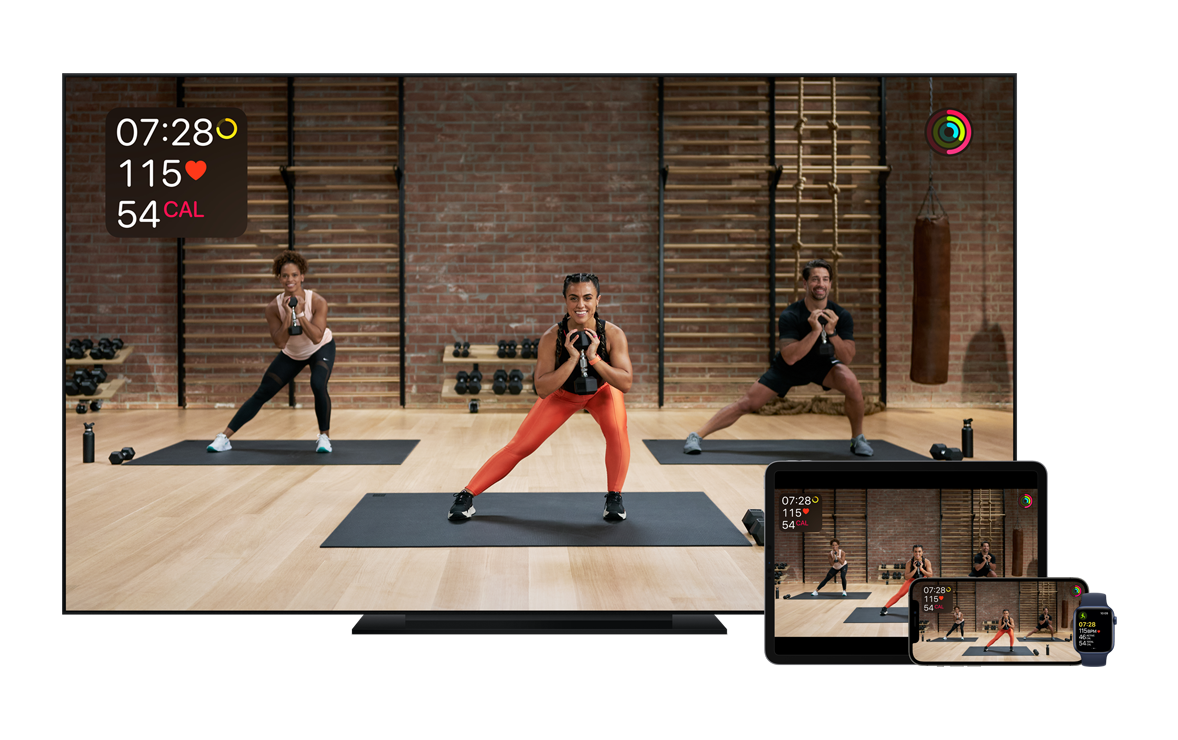
Image Credits: Apple
Honestly, the Apple Watch integration is probably the best-executed aspect of the entire undertaking — down to the way the wearable doubles as a start and stop button for the workout. It also ensures a more complete rundown of your workouts at the end of the day. The truth of a wrist-worn monitor — whether Apple wants to admit it or not — is that it can be hit or miss with full body workouts.
That’s a big part of the reason why the device asks you to start or confirm workout types during normal usage. Give the current sensor technology available for these products, there’s a limit to how precisely you can measure movement. If you’re wearing the Watch and doing pre-selected Fitness+ workouts, on the other hand, the system is able to offer a more complete picture. Collected data is also aggregated into a “Burn Bar,†which will show you roughly where you rank compared to others who have done the exercises (I generally found myself somewhere in the middle). This can be toggled off if you’re not feeling competitive.
Beyond that, there’s really not much in the way of gamification here. The closest Apple’s hand-selected trainers come is the fairly regular encouragement to “close your rings.†It’s tough to strike the balance of motivating without overwhelming. Go too far in either direction and you risk losing people. I’d say on the whole Apple does a decent job striking the balance, down to the fact that there are often three trainers in the videos, each showing you a different level of intensity for the on-screen exercises.
One key thing Apple does lose here, versus both in-person fitness classes and live-streamed ones from the likes of Peloton, is instant feedback. The company has positioned its “on-demand†approach as a way of letting users complete courses at their own pace. In a more ideal world, however, there would be some combination of the two. Apple certainly has the resources to do both — though there’s a fair bit more that goes into live-streaming with real-time bio feedback.
If I had to venture a guess here, I would say that in all likelihood Apple will add live classes at some point. There’s value in having a set appointment you feel obligated to attend. And for all of the Fitness+ trainers’ encouragement that “you’re doing great,†let’s be real: they’re speaking to a camera in a studio for a video that was recorded days — if not weeks — ago.
YOU HAVE NO IDEA HOW I’M DOING!
The variety of exercises on offer is pretty good. I’ve mostly been alternating between Core and HIIT (high intensity interval training). Given that it’s all right there in front of me, I have found myself trying some new stuff. Turns out I still hate dancing in basically all of its forms — but it’s nice to check in every decade or so. The biggest limitation for me (beyond those outlined above) is equipment.
I don’t have a stationary bike or treadmill. I have a kettlebell, but not a complete weight set. I do have a yoga mat, however, which is probably the most common piece of equipment here. Honestly, if you’re thinking of trying Fitness+, I would shell out $25 for a yoga mat. Turns out you can still use it even if you cancel your account. There’s a small description letting you know what equipment is needed below the video. It would be great if Apple added an easie way to filter by equipment, though, given the percentage of workouts that require something.
Ditto for music. Apple really prides itself on the music choices here (and the trainers seems encourage to talk a lot about it). In fact, each course includes an Apple Music playlist of the song choices (ecosystems for the win). I recognize that music choices are every bit as personal as fitness needs, so I know I’m not speaking for everyone when I say the music is, on a whole, mostly bad. As you’d expect.
There are exceptions for different trainers and different exercises, but the selections I mostly encountered in my workouts are more or less the same sort of high energy Top 40 crap you’ve probably already encountered at your gym. If that’s your thing, cool. If not, you’re going to find the alternatives fewer and farther between. I would love if Apple eventually adds an option to toggle off the music or replace it with your own stuff. You can filter by genre within a given exercise category, but for obvious reasons, that’s going to limit the workout selections in the process.
Once you’ve completed a course, a small checkmark will show up in the corner. It sticks around, which is nice if you find something you like, but it would be great if the app more dynamically cycled through things and offered quick reference for what you’ve already done. Again, this is all coming from someone who’s done six or so workouts over three or so days. The app adds customization the more you use it, and I just haven’t been using it long enough.
Image Credits: Apple
The overall execution is about as polished as you’d expect from an Apple production, down to the fact that the trainers were taught some sign language for greetings and goodbyes (in addition to closed captioning). Money has been spent on production value and hiring a diverse group of trainers. And certainly you’re getting more consistent quality here than you would just perusing YouTube for random exercises.
Is it worth $10 a month (or $80 a year), though? My main hesitation on that front is that it’s yet another in a seemingly endless pile of monthly fees from the ever-growing subscription economy. It’s significantly cheaper than a gym, obviously. Though the equipment here is very much bring your own, in the case of Apple, and the Watch doesn’t take the place of in-person feedback from classes or even the kind offered on some of the full-body fitness mirrors.
Like I said at the top I plan to keep using the app for the timing being. I’m still wary of the gym and am generally averse to working out in front of others. And thankfully, I live on the first floor, so none of my neighbors are any the wiser about all of the weird jumping around I’ve been doing lately (though my rabbit finds it amusing).
Here in the States, at least, it seems a safe bet we’ve got at least another four, maybe five months of this pandemic left to deal with. For Apple, that means a solid opportunity to get people on board with its new service. For me, it probably means at least that much more time doing squats in front of an iPad — especially as we’re heading into some truly cold months here on the eastern seaboard. I’ll probably check in my progress in a few weeks or months and maybe feel more comfortable calling it a proper review.
Beyond that, it’s hard to say.



No comments:
Post a Comment