
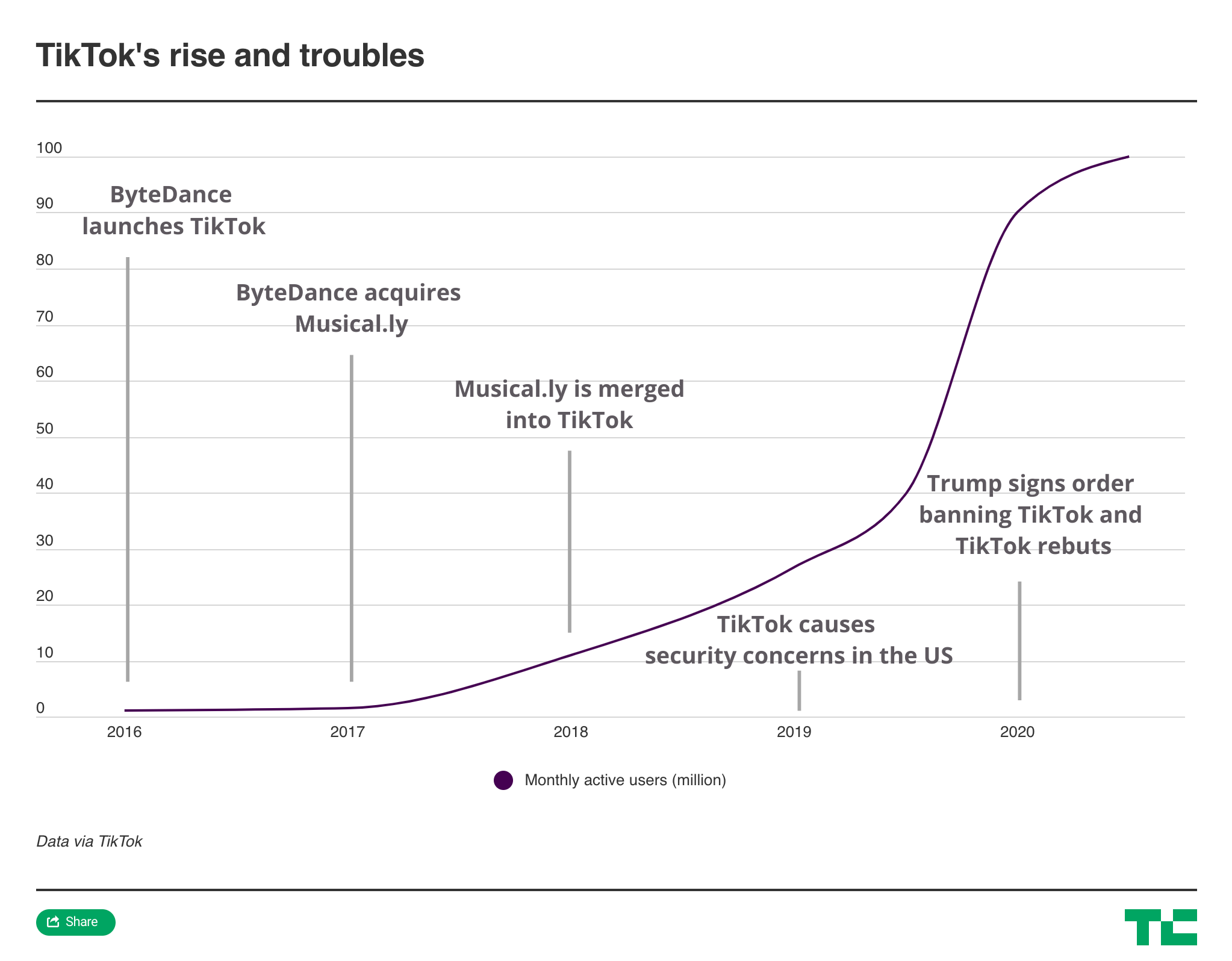
TikTok’s rise in the West is unprecedented for any Chinese tech company, and so is the amount of attention it has attracted from politicians worldwide. Below is a timeline of how TikTok grew from what some considered another “copycat†short video app to global dominance and eventually became a target of the U.S. government.
2012-2017: The emergence of TikTok
These years were a period of fast growth for ByteDance, the Beijing-based parent company behind TikTok. Originally launched in China as Douyin, the video-sharing app quickly was wildly successful in its domestic market before setting its sights on the rest of the world.Â
2012Â
Zhang Yiming, a 29-year-old serial engineer, establishes ByteDance in Beijing.
2014
Chinese product designer Alex Zhu launches Musical.ly.
2016
ByteDance launches Douyin, which is regarded by many as a Musical.ly clone. It launches Douyin’s overseas version TikTok later that year.
2017-2019: TikTok takes off in the United States
TikTok merges with Musical.ly and and launches in the U.S., where it quickly becomes popular, the first social media app from a Chinese tech company to achieve that level of success there. But at the same time, its ownership leads to questions about national security and censorship, against the backdrop of the U.S.-China tariff wars and increased scrutiny of Chinese tech companies (including Huawei and ZTE) under the Trump administration.
2017
November
ByteDance buys Musical.ly for $800 million to $1 billion. (link)
2018
August
TikTok merges with Musical.ly and becomes available in the U.S. (link)
October
TikTok surpassed Facebook, Instagram, Snapchat and YouTube in downloads. (link)
November
Facebook launches TikTok rival Lasso. (link)
2019
February
TikTok reaches one billion installs on the App Store and Google Play. (link)
The U.S. Federal Trade Commission fines TikTok $5.7 million over violation of children privacy law. (link)
May
TikTok tops the App Store for the fifth quarter in a row. (link)
September
TikTok is found censoring topics considered sensitive by the Beijing government. (link)
October
TikTok bans political ads (link) but does not appear to take action on hashtags related to American politics. (link)
TikTok taps corporate law firm K&L Gates for advice on content moderation in the U.S. (link)
U.S. lawmakers ask intelligence chief Joseph Maguire to investigate if TikTok poses a threat to national security. (link)
TikTok says it has never been asked by the Chinese government to remove any content and would not do so if asked. (link)
November
The Committee on Foreign Investment in the United States reportedly opens a national security probe into TikTok. (link)
Instagram launches TikTok rival Reels. (link)
TikTok apologizes for removing a viral video about abuses against Uighurs. (link)
December
The U.S. Navy reportedly bans TikTok. (link)
The first half of 2020: Growth amid government scrutiny
The app is now a mainstay of online culture in America, especially among Generation Z, and its user base has grown even wider as people seek diversions during the COVID-19 pandemic. But TikTok faces an escalating series of government actions, creating confusion about its future in America.Â
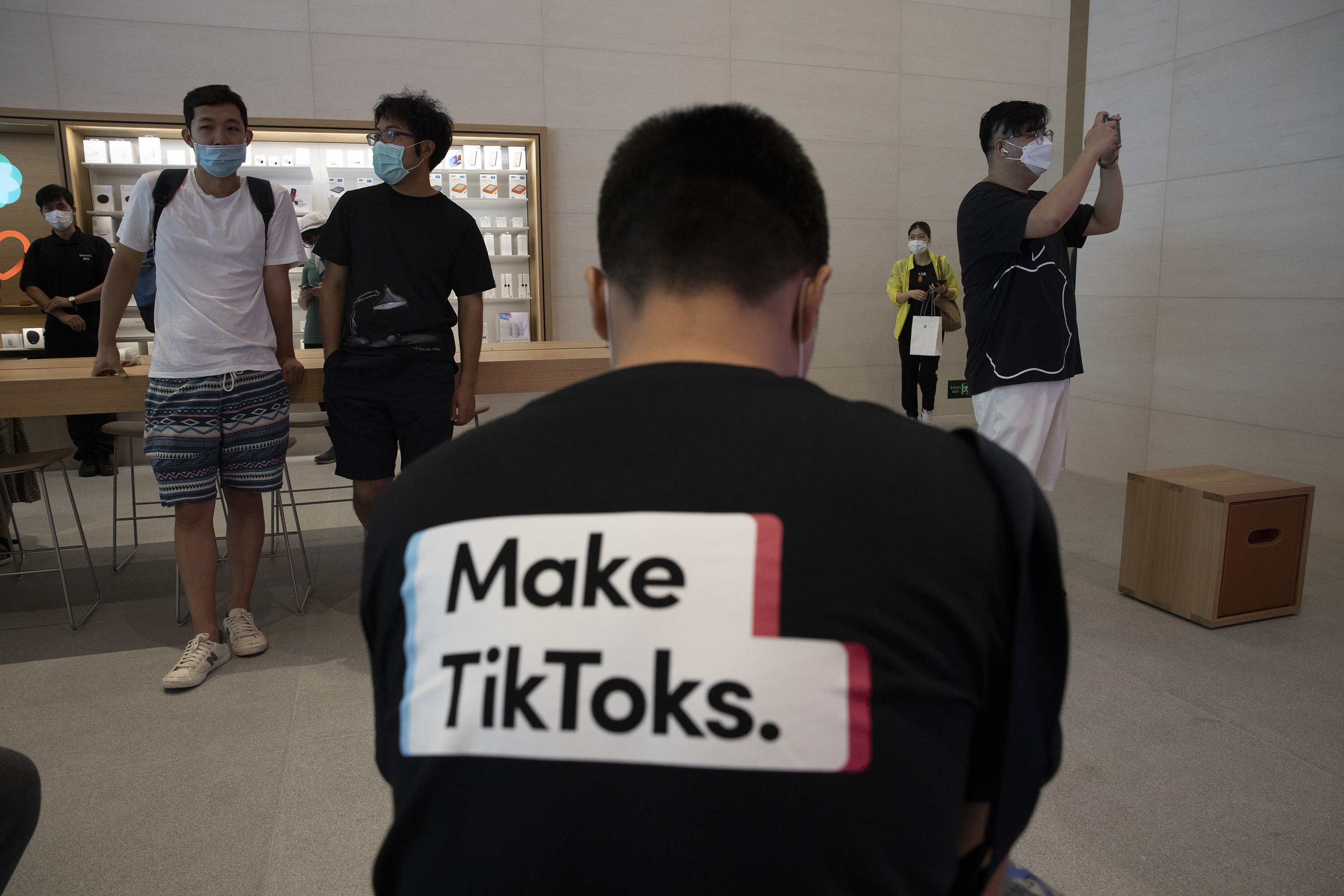
A man wearing a shirt promoting TikTok is seen at an Apple store in Beijing on Friday, July 17, 2020. (AP Photo/Ng Han Guan)
2020
January
Revived Dubsmash grows into TikTok’s imminent rival. (link)
March
TikTok lets outside experts examine its moderation practices at its “transparency center.†(link)
Senators introduce a bill to restrict the use of TikTok on government devices. (link)
TikTok brings in outside experts to craft content policies. (link)
April
TikTok introduces parental controls. (link)
TikTok tops two billion downloads. (link)
June
TikTok discloses how its content recommendation system works. (link)
YouTube launches TikTok rival. (link)
July
Facebook shuts down TikTok rival Lasso. (link)
Secretary of State Mike Pompeo says the U.S. is looking to ban TikTok. (link)
TikTok announced a $200 million fund for U.S. creators. (link)
Trump told reporters he will use executive power to ban TikTok. (link)
The second half of 2020: TikTok versus the U.S. government
After weeks of speculation, Trump signs an executive order in August against ByteDance. ByteDance begins seeking American buyers for TikTok, but the company also fights the executive order in court. A group of TikTok creators also file a lawsuit challenging the order. The last few months of 2020 become a relentless, and often confusing, flurry of events and new developments for TikTok observers, with no end in sight.Â
August
Reports say ByteDance agrees to divest TikTok’s U.S. operations and Microsoft will take over. (link)
Trump signals opposition to the ByteDance-Microsoft deal. (link)
Microsoft announces discussions about the TikTok purchase will complete no later than September 15. (link)
Trump shifts tone and says he expects a cut from the TikTok sale. (link)
TikTok broadens fact-checking partnerships ahead of the U.S. election. (link)
August 7: In the most significant escalation of tensions between the U.S. government and TikTok, Trump signs an executive order banning “transactions†with ByteDance in 45 days, or on September 20. (link). TikTok says the order was “issued without any due process†and would risk “undermining global businesses’ trust in the United States’ commitment to the rule of law.†(link)
August 9: TikTok reportedly plans to challenge the Trump administration ban. (link)
Oracle is also reportedly bidding for the TikTok sale. (link)
August 24: TikTok and ByteDance file their first lawsuit in federal court against the executive order, naming President Trump, Secretary of State Wilbur Ross and the U.S. Department of Commerce as defendants. The suit seeks to prevent the government from banning TikTok. Filed in U.S. District Court Central District of California (case number 2:20-cv-7672), it claims Trump’s executive order is unconstitutional.  (link)
TikTok reaches 100 million users in the U.S. (link)
August 27: TikTok CEO Kevin Mayer resigns after 100 days. (link)
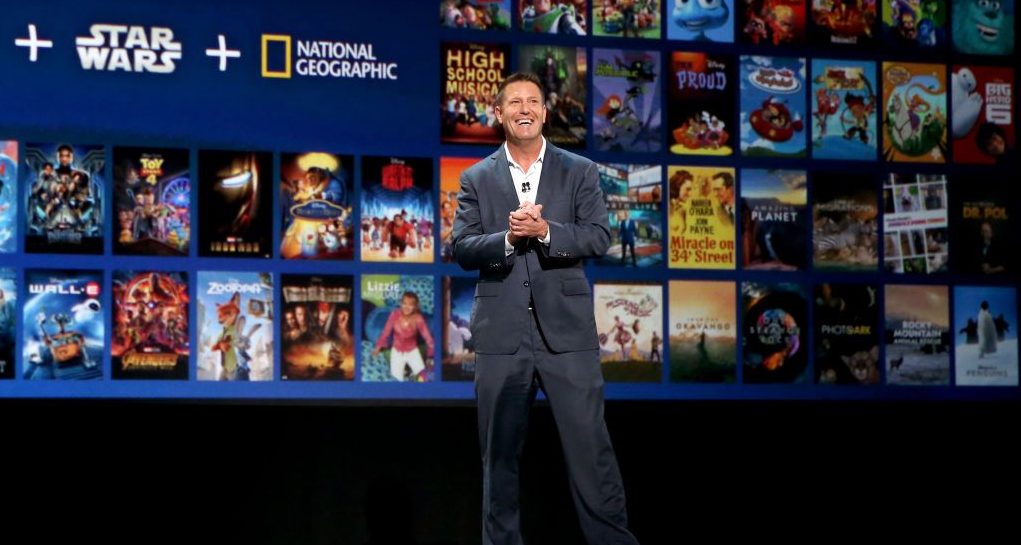
Kevin Mayer (Photo by Jesse Grant/Getty Images for Disney)
Walmart says it has expressed interest in teaming up with Microsoft to bid for TikTok. (link)
August 28: China’s revised export laws could block TikTok’s divestment. (link)
September
China says it would rather see TikTok shuttered than sold to an American firm. (link)
September 13: Oracle confirms it is part of a proposal submitted by ByteDance to the Treasury Department in which Oracle will serve as the “trusted technology provider.†(link)
September 18: The Commerce Department publishes regulations against TikTok that will take effect in two phases. The app will no longer be distributed in U.S. app stores as of September 20, but it gets an extension on how it operates until November 12. After that, however, it will no longer be able to use internet hosting services in the U.S., rendering it inaccessible. (link)
On the same day as the Commerce Department’s announcement, two separate lawsuits are filed against Trump’s executive order against TikTok. One is filed by ByteDance, while the other is by three TikTok creators.
The one filed by TikTok and ByteDance is in U.S. District Court for the District of Columbia (case number 20-cv-02658), naming President Trump, Secretary of Commerce Wilbur Ross and the Commerce Department as defendants. It is very similar to the suit ByteDance previously filed in California. TikTok and ByteDance’s lawyers argue that Trump’s executive order violates the Administrative Procedure Act, the right to free speech, and due process and takings clauses.
The other lawsuit, filed by TikTok creators Douglas Marland, Cosette Rinab and Alec Chambers, also names the president, Ross and the Department of Commerce as defendants. The suit, filed in the U.S. District Court for the Eastern District of Pennsylvania (case number 2:20-cv-04597), argues that Trump’s executive order “violates the first and fifth amendments of the U.S. Constitution and exceeds the President’s statutory authority.â€
September 19: One day before the September 20 deadline that would have forced Google and Apple to remove TikTok from their app stores, the Commerce Department extends it by a week to September 27. This is reportedly to give ByteDance, Oracle and Walmart time to finalize their deal.
On the same day, Marland, Rinab and Chambers, the three TikTok creators, file their first motion for a preliminary injunction against Trump’s executive order. They argue that the executive order violates freedom of speech and deprives them of “protected liberty and property interests without due process,†because if a ban goes into effect, it would prevent them from making income from TikTok-related activities, like promotional and branding work.
September 20: After filing the D.C. District Court lawsuit against Trump’s executive order, TikTok and ByteDance formally withdraw their similar pending suit in the U.S. District Court of Central District of California.
September 21: ByteDance and Oracle confirm the deal but send conflicting statements over TikTok’s new ownership. TikTok is valued at an estimated $60 billion. (link)
September 22: China’s state newspaper says China won’t approve the TikTok sale, labeling it “extortion.†(link)
September 23: TikTok and ByteDance ask the U.S. District Court for the District of Columbia to grant a preliminary injunction against the executive order, arguing that the September 27 ban removing TikTok from app stores will “inflict direct, immediate, and irreparable harm on Plaintiffs during the pendency of this case.†(link)
September 26: U.S. District Court Judge Wendy Beetlestone denies Marland, Rinab and Chambers’ motion for a preliminary injunction against the executive order, writing that the three did not demonstrate “they will suffer immediate, irreparable harm if users and prospective users cannot download or update†TikTok after September 27, since they will still be able to use the app.
September 27: Just hours before the TikTok ban was set to go into effect, U.S. District Court Judge Carl J. Nichols grants ByteDance’s request for a preliminary injunction while the court considers whether the app poses a risk to national security. (link)
September 29: TikTok launches a U.S. election guide in the app. (link)
October
WASHINGTON, DC – AUGUST 07: In this photo illustration, comedian Sarah Cooper’s page is displayed on the TikTok app. (Photo Illustration by Drew Angerer/Getty Images)
Snapchat launches a TikTok rival. (link)
TikTok says it’s enforcing actions against hate speech. (link)
TikTok partners with Shopify on social commerce (link)
October 13: After failing to win their first request for a preliminary injunction, TikTok creators Marland, Rinab and Chambers file a second one. This time, their request focuses on the Commerce Department’s November 12 deadline, which they say will make it impossible for users to access or post content on TikTok if it goes into effect.
October 30: U.S. District Judge Wendy Beetlestone grants TikTok creators Marland, Chambers and Rinab’s second request for a preliminary injunction against the TikTok ban. (link)
November
November 7: After five days of waiting for vote counts, Joe Biden is declared the president-elect by CNN, followed by the AP, NBC, CBS, ABC and Fox News. With Biden set to be sworn in as president on January 20, the future of Trump’s executive order against TikTok becomes even more uncertain.
November 10: ByteDance asks the federal appeal court to vacate the U.S. government’s divestiture order that would force it to sell the app’s American operations by November 12. Filed as part of the lawsuit in D.C. District Court, ByteDance said it asked the Committee on Foreign Investments in the United States for an extension, but hadn’t been granted one yet. (link)
November 12: This is the day that the Commerce Department’s ban on transactions with ByteDance, including providing internet hosting services to TikTok (which would stop the app from being able to operate in the U.S.), was set to go into effect. But instead the case becomes more convoluted as the U.S. government sends mixed messages about TikTok’s future.
The Commerce Department says it will abide by the preliminary injunction granted on October 30 by Judge Beetlestone, pending further legal developments. But, around the same time, the Justice Department files an appeal against Beetlestone’s ruling. Then Judge Nichols sets new deadlines (December 14 and 28) in the D.C. District Court lawsuit (the one filed by ByteDance against the Trump administration) for both sides to file motions and other new documents in the case. (link)
November 25: The Trump administration grants ByteDance a seven-day extension of the divestiture order. The deadline for ByteDance to finalize a sale of TikTok is now December 4.
This timeline will be updated as developments occur.



No comments:
Post a Comment