
For Tesla to reach the ambitious goal of 10 to 20 terawatt hours of battery production per year that the company has set, it will need to advance the battery and its production.
Today, during Tesla’s self-described Battery Day event, the company laid out a series of innovations that its CEO Elon Musk said will get it there. And it all starts with a new construction of the battery itself.
As part of its announcements, the company has announced the creation of a new cell design, which the company said has a new 80 millimeter length that will give the cells five times the energy density, six times the power, and enable a 16% increase in range.
“We’re starting to ramp up manufacturing of these cells at our pilot 10 gigawatt manufacturing facility just around the corner,†said Drew Baglino, the SVP of powertrain and energy engineering at Tesla.
However, it should be noted that this new cell manufacturing system isn’t actually working yet. It’s “close to working†at the pilot plant level, Musk added.
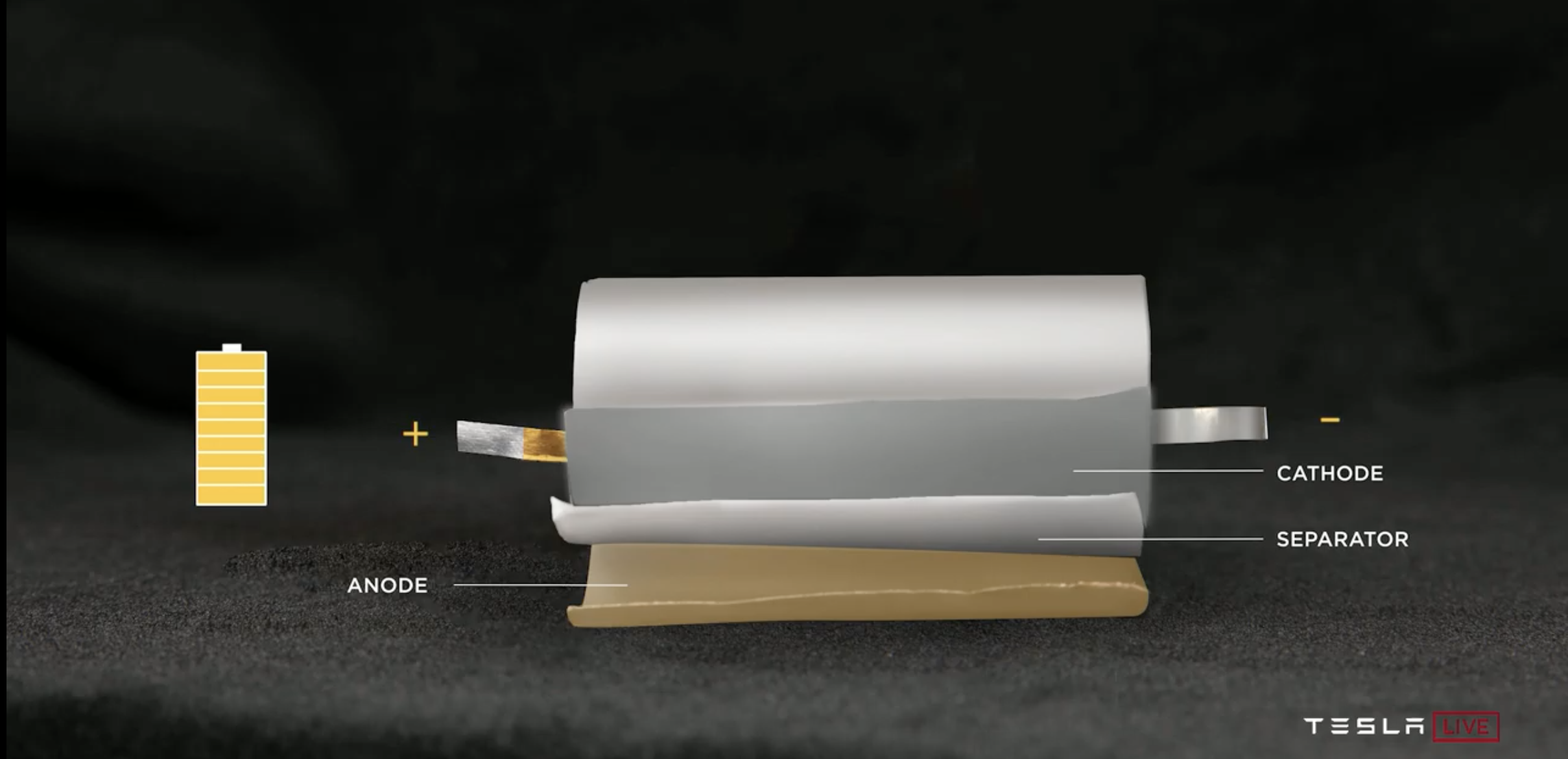
Traditional batteries are made of three components: the anode, the cathode and the separator. In addition to that basic battery structure, there are tabs that allow a cell’s energy to be transferred to an external source. Large-format lithium-ion cells have a “foil-to-tab†weld to collect the foils inside a cell and join them to a tab.
Lithium ions flow from the anode to the cathode through the separator to discharge and charge the battery. The process has been the same for batteries for decades and the changes have been mostly in the material science, and changes to the size of the battery.
Image of a traditional lithium ion battery and its components: the anode, cathode and separator. Image Credit: TeslaÂ
Those changes in size to increase power and density come with thermal issues, Baglino said.
“This was the challenge that our team set its sights on to overcome,†Baglino said. “We came up with this tabless architecture that removes the thermal problem from the equation that allows us to go to the absolute lowest cost form factor and the simplest manufacturing process.â€
Tesla took the existing foils and laser patterned them and enabled dozens of connections into the active material through a shingled spiral. That new design means simpler manufacturing, fewer parts and a shorter electrical path length, which is how Tesla gets the thermal benefits it claims, according to Baglino.
“For cylindricals to be able to get rid of the tabs dramatically simplifies winding and coating and has an awesome thermal and performance benefit,†said Baglino.
Musk agrees. “It’s really a huge pain in the ass to have tabs,†Musk said during the event.
By reducing the distance the electron has to travel, the cell has less thermal issues and a shorter path length in a larger tabless cell, according to Musk, who explained that though the cell is bigger, the power to weight ratio is better than a smaller cell with tabs.
“This is quite hard to do,†said Musk. “Nobody’s done it before. So… it really took a tremendous amount of effort within Tesla engineering to figure out how do we make a fricking tabless cell and make it actually work and connect it to the top cap.â€
It’s the first of several steps that the company is taking to ramp up energy storage on its quest to move the world that much closer to renewable energy.
“It took us a lot of trials but we’re very happy where we ended up,†said Baglino.
Click here for more...
from #Bangladesh #News aka Bangladesh News Now!!!



No comments:
Post a Comment