
The European Union’s top court has handed down its first decision on the bloc’s net neutrality rules — interpreting the law as precluding the use of commercial ‘zero rating’ by Internet services providers.
‘Zero rating’ refers to the practice of ISPs offering certain apps/services ‘tariff free’ by excluding their data consumption. It’s controversial because it can have the effect of penalizing and/or blocking the use of non-zero-rated apps/services, which may be inaccessible while the zero rated apps/services are not — which in turn undermines the principal of net neutrality with its promise of fair competition via an equal and level playing field for all things digital.
The pan-EU net neutrality regulation came into force in 2016 amid much controversy over concerns it would undermine rather than bolster a level playing field online. So the Court of Justice of the EU (CJEU)’s first ruling interpreting the regulation is an important moment for regional digital rights watchers.
The #ECJ interprets, for the first time, the #EU regulation enshrining #InternetNeutrality with regards to the #Internet users’ rightshttps://t.co/ATb3CgbPxg
— EU Court of Justice (@EUCourtPress) September 15, 2020
Despite the existence of a net neutrality regulation, European carriers have continued offering packages that ‘zero rate’ certain apps, such as Facebook-owned WhatsApp, for example — raising questions over whether such offers comply with the rules. Today’s ruling suggests they do not.
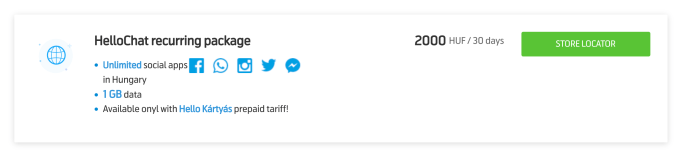
In another example from Hungary, one of carrier Telenor’s 1GB data tariffs (screengrabbed below) touts unlimited domestic data consumption for a number of social apps, including Facebook, WhatsApp, Messenger, Instagram and Twitter — meaning all other apps/services are at a disadvantage as usage is throttled by the user’s 1GB allowance.
A Budapest court hearing two actions against Telenor, related to two of its ‘zero rating’ packages, made a reference to the CJEU for a preliminary ruling on how to interpret and apply Article 3(1) and (2) of the regulation — which safeguards a number of rights for end users of Internet access services and prohibits service providers from putting in place agreements or commercial practices limiting the exercise of those rights — and Article 3(3), which lays down a general obligation of “equal and non-discriminatory treatment of trafficâ€.
The court found that ‘zero rating’ agreements that combine a ‘zero tariff’ with measures blocking or slowing down traffic linked to the use of ‘non-zero tariff’ services and applications are indeed liable to limit the exercise of end users’ rights within the meaning of the regulation and on a significant part of the market.
“Such packages are liable to increase the use of the favoured applications and services and, accordingly, to reduce the use of the other applications and services available, having regard to the measures by which the provider of the internet access services makes that use technically more difficult, if not impossible. Furthermore, the greater the number of customers concluding such agreements, the more likely it is that, given its scale, the cumulative effect of those agreements will result in a significant limitation of the exercise of end users’ rights, or even undermine the very essence of those rights,†the court writes in a press release.
It also found that no assessment of the effect of measures blocking or slowing down traffic on the exercise of end users’ rights is required by the regulation, while measures applied for commercial (rather than technical) reasons must be regarded as automatically incompatible.
The full CJEU judgement is available here in French and Hungarian. (Update: And in English here.)
Click here for more...
from #Bangladesh #News aka Bangladesh News Now!!!



No comments:
Post a Comment